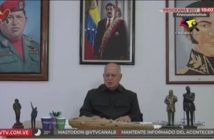
Diosdado Cabello is considered the most dangerous man in the current Venezuelan system due to his ability to combine political power with direct control of physical force and intelligence. Following the capture of Nicolás Maduro in early January 2026, Cabello emerged as the leader of the radical wing of the resistance, using his position to mobilize both official troops and shock troops.
He is an Army Captain from the class of 1987. Although formally retired, his influence over the current military command is absolute, as he is the key link between the party and the barracks.
His positions have included Minister of the Interior, Justice, and Peace, and he is the First Vice President of the PSUV. From this ministry, he controls the intelligence agencies (SEBIN and DGCIM) and the police forces.
He has a long history of repression and accusations. His record is marked by systematic accusations of human rights violations and persecution:
He is the Repressive Apparatus, which is why international organizations such as the UN Mission and the OAS identify him as the architect of political persecution. He is held responsible for coordinating arbitrary detentions, torture, and enforced disappearances under the doctrine of the internal enemy. He kidnaps people at night and subjects them to torture, including enforced disappearance, where the family spends months without any news of the detained person.
He is the head of Operation Tun-Tun: He has institutionalized the harassment of the homes of opposition members and ordinary citizens, using his television program, Con El Mazo Dando, to target people who are later arrested.
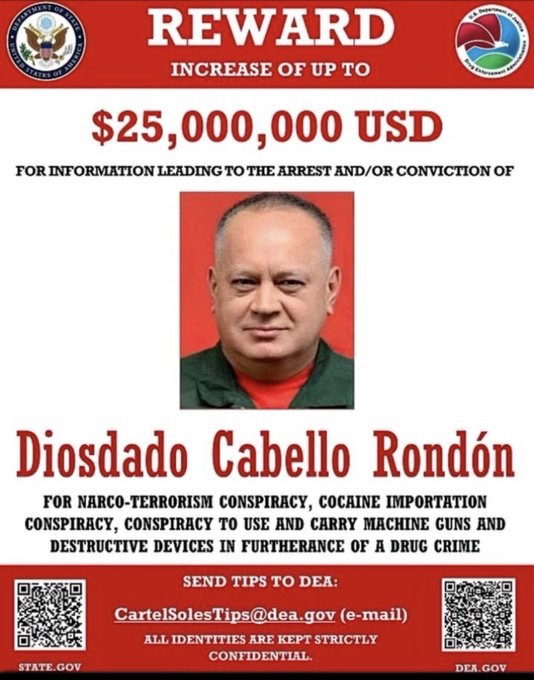
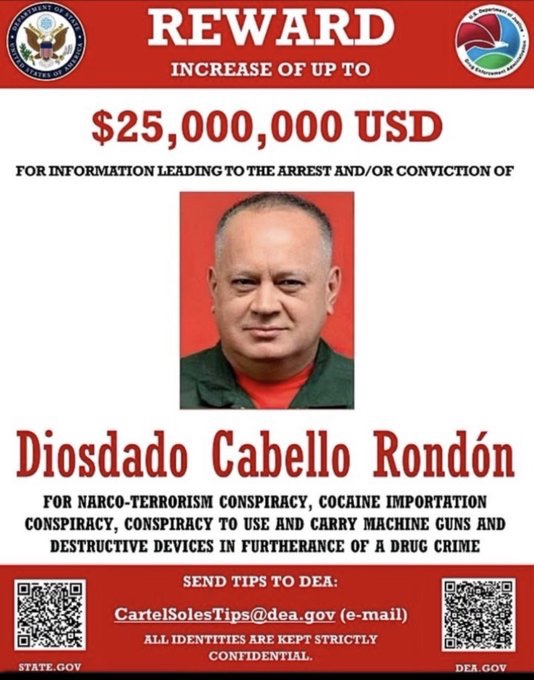
Diosdado Cabello is subject to an international arrest warrant. In September 2024, Argentine authorities issued a warrant for his arrest for crimes against humanity, and the U.S. government is currently offering a $25 million reward for information leading to his capture (January 2026), linking him to narcoterrorism through the Cartel of the Suns later reported as not having actually existed according to NYT and a claim dropped by StateDept.
His brother, José David Cabello, is the financial arm of the regime and an indispensable complement to its system:
He has held the position of Superintendent of SENIAT (Customs and Tax Administration) for 18 years.
He controls the flow of goods and the country’s tax collection. International investigations identify him as the logistics operator who facilitates money laundering and controls strategic trade routes for the benefit of his family. Like his brother, he is sanctioned by the European Union, the U.S., and Canada for massive corruption.
Analysts and human rights advocates consider Diosdado Cabello’s continued hold on power to be the greatest obstacle to a peaceful transition for the following reasons:
Radicalization of violence: Feeling cornered after Maduro’s fall, he has threatened to turn Venezuela into an urban guerrilla battleground, using civilian militias.
Institutional gridlock: His control of the security forces prevents other sectors of the government from negotiating a diplomatic solution, deepening international isolation and the humanitarian crisis.
The continuation of his administration implies the existence of a de facto state of emergency, where any dissent faces immediate arrest and exemplary punishment.
The number of people harmed by Diosdado Cabello is extensive, ranging from high-profile political leaders to ordinary citizens, journalists, and foreigners. His dangerousness lies in the fact that he not only orders repression from behind a desk, but also announces and celebrates it publicly, turning the judicial system into a personal weapon.
Based on reports from the UN (2025), the IACHR, and recent events from January 2026, these are the categories of direct victims: Political Leaders and Activists (Direct Persecution). Citizens in Operation Tun-Tun. This is his cruelest facet, affecting people without political power: Protesters and residents:
Following the protests of 2024 and 2025, Cabello ordered the arrest of more than 2,200 people, including 150 minors. Election observers: Citizens who were simply watching over votes were taken from their homes in the early morning by SEBIN commandos after being denounced by Cabello’s cooperating patriots (paid informants) and victims of his program “Con el Mazo Dando”
The UN documented that being mentioned on this program amounts to a de facto arrest warrant. Journalists and NGOs: Dozens of journalists have had to flee the country after Cabello displayed their photos and addresses on television. A clear example is the Mercenaries Case: In 2024 and 2025, Cabello presented foreign nationals (Spanish, American, and Czech) on camera, accusing them without evidence of being hitmen. These individuals were subjected to psychological torture and confinement before being used as political bargaining chips.
Cases of Extreme Gravity (Murders and Torture): Ronald Ojeda: International investigations and testimonies from dissidents link the kidnapping and subsequent murder of former military officer Ronald Ojeda in Chile (February 2024) to the intelligence structure that answers to Cabello. According to internal sources, the perpetrator was Lieutenant Colonel Alexander Granko, who was also responsible for the murders of Óscar Pérez and his team, as well as Lieutenant Commander Rafael Acosta Arévalo.
There are also many military personnel who have been kidnapped, disappeared, tortured, and imprisoned, considered dangerous to the regime and Diosdado Cabello.
The deaths during the protests, for which he is blamed for the deaths of at least 25 people during the 2024 crackdown, were perpetrated by forces now under his direct control (the Bolivarian National Police and armed groups, also known as Colectivos).
With Maduro’s recent capture by U.S. forces, Cabello has become even more dangerous. Reports in the last few days indicate that he has ordered the targeted killings of military personnel who attempted to support the transition.
Attacks against civilians: Clashes have been reported in which forces under his command have caused civilian casualties; it is estimated that more than 100 people have died in the last few weeks in his attempt to maintain territorial control.
If Cabello is not removed, the country risks becoming an urban guerrilla stronghold, where the law is replaced by the whims of a man who has nothing to lose, knowing that his ultimate fate is international justice.
Diosdado Cabello is internationally sanctioned and has an arrest warrant issued by the US. The international sanctions against Diosdado Cabello and his inner circle function as a financial and legal cordon designed to limit their operations.
By the European Union (EU): Recently renewed until January 10, 2027.
He has an absolute ban on entering any EU country and all his assets and bank accounts in European territory are frozen.
He is directly accused of torture, arbitrary detentions, and undermining democracy in Venezuela.
United States: There is a $25 million reward for Cabello’s capture. He faces charges of narcoterrorism and leading the Cartel of the Suns-later reported by NYT and other media as “not a real group” after Justice Dept drops claim of its existence
His brother (José David), his wife (Marleny Contreras), and his daughter (Daniela Cabello) are also sanctioned, preventing any attempt to transfer family assets through the Western financial system.
Switzerland, Canada, and Panama maintain sanctions against him for money laundering and human rights violations. Panama classifies him as a high-risk individual for financing terrorism.
In Argentina, there is an outstanding international arrest warrant issued by its courts for crimes against humanity.
These sanctions have made Cabello an international pariah. He cannot travel, he cannot legally use the global banking system, and his freedom comes at a price.